Showing posts with label History. Show all posts

Friday, 16 July 2021

Making Junk of Dicynodont Trunks

Bill Munn's sculpture of a trunked Giraffatitan.
Classic imagery. Original photo featured on Cryptomundo, I think?

In the realms of the palaeo-blogosphere, one article I would consider to be essential reading is Tetrapod Zoology's Junk in the trunk: why sauropod dinosaurs did not possess trunks, which speaks for itself (and apologies to Darren for shamelessly riffing on his title).

As I'm sure some of you are familiar with, it’s become a fairly recurring pattern in vertebrate palaeontology for certain clades with peculiar nasal anatomy to be (often ultimately incorrectly) proposed to have had trunks. The idea of trunked sauropods has been decidedly debunked, dismissed and derided, but even such well established examples of purportedly trunked fossil tetrapods like Macrauchenia have recently been proposed to be stripped of their proboscises on account of incompatible musculature and other anatomical grounds.

But did you know that dicynodonts also got in on the trunk craze? Given that you're here and read the title, I'd imagine you'd already guessed that. But did you also know that they got in on the craze almost a whole century ahead of the game? Yes indeed, it may be seldom acknowledged nowadays but there really was one time when a dicynodont was proposed to have had a trunk. It wasn't just any dicynodont either, but arguably one of the more famous names in the dicynodont roster, Kannemeyeria, and in fact the original specimen from which it was named to boot.

Kannemeyeria was coined by British palaeontologist Harry Seeley (of Saurischia and Ornithischia fame) in September of 1908 at the 78th meeting of The British Association, published as a brief description just over half a page long. Seeley unfortunately died just some months later in January of 1909, and to my knowledge Kannemeyeria may be one the last taxa he ever named. However, it was not for the familiar K. simocephalus we know today. Indeed, that species had already been named twenty years earlier in 1888 by German palaeontologist Anton Weithofer, who regarded it as a species of Dicynodon (as of course was tradition for many dicynodont fossils in the 19th and early 20th century).
Seeley named Kannemeyeria from a peculiar partial skull discovered in the Karoo Basin of South Africa by fossil collector (among various other professions) Dr. Daniel Rossouw Kannemeyer in 1895, whose find would ultimately bear his name. The skull was, in Seeley's words, "not perfect" and pretty busted up and incomplete, but Seeley recognised it as a dicynodont for its toothless jaws and paired tusks (which I assume are broken, as I can't make them out much in the few images I could find of the fossil —scratch that, better photos provided by Dr. Christian Kammerer below more clearly show the tusks set in the jaw). However, one feature stood out to Seeley that compelled him to describe it as an entirely new genus and species that he named Kannemeyeria proboscoides. You can probably guess why.
Seeley's type specimen of Kannemeyeria proboscoides, viewing the left side from slightly above (a), underside (b), and the top side (c). The specimen's not very pretty, and neither are the pictures, but it's the best I could find (UPDATE: better quality photos have been provided at the bottom of the post!). From Cruickshank (1970).

Yes, Seeley was quite convinced that this was a hitherto unknown dicynodont with a trunk, and adamantly so at that. He explicitly described the area for the trunk insertion as being elephantine in structure, not like the short and stout proboscis of a tapir. Now usually in cases like these it’s at least understandable how a certain fossil's anatomy can invoke the possibility of a trunk: raised nostrils, large narial openings, abbreviated snouts, and so on. But how does the beaked skull of a dicynodont, which typically have small nostril openings I might add, even come remotely close to looking like it should have a trunk?
The simple answer is that the specimen Kannemeyer found was broken, and that the bean-shaped opening left behind by the broken-off snout was interpreted as the entire nasal aperture. In fact, most of the skull is missing, it's mostly a palate with part of the top of the snout and a left eye, the rest is all missing. In hindsight, the beak simply just being broken off sounds glaringly obvious, but let’s be kind to Seeley. The scope of dicynodont anatomy was still poorly understood at the time, and the tusk-bearing region was still roughly intact, so it's not inconceivable to have interpreted a large forward-opening hole in the skull as a natural feature. After all, by itself it's not that outrageous, especially when it recalls to mind another famously trunked synapsid with a large, vaguely bean-shaped opening on the front of its skull and a prominent pair of tusks. 
Synapsid? Check! Two tusks? Double check!
Vaguely bean-shaped narial opening? Check! Kannemeyeria proboscoides confirmed.
Photo byJimJones1971 (CC BY-SA 3.0).
The story gets even more interesting, though. Seeley went on to speculate on the lifestyle and habits of his Kannemeyeria proboscoides in surprising detail. He concluded that Kannemeyeria was something like an aardvark or giant anteater, using its tusks to rip open and tear down termite nests, a trait he ascribed to other dicynodonts as well. Quite how the trunk was involved with this is a bit of a puzzle to me, admittedly. He compares it to the elongated snouts of aardvarks and anteaters as a "soft flexible" extension of the head, but in these mammals the snout is stiff and tubular with the mouth situated at the very end, totally unlike the short jaws and trunk of elephants. Was it supposed to suck them up the way anteaters do in cartoons? Who knows.
Whatever Seeley exactly had in mind for Kannemeyeria, it didn't stick. Just four years later, David M.S. Watson recognised that Seeley's skull was an imperfect specimen of Weithofer's Dicynodon simocephalus, and while opinions on the internal taxonomy of Kannemeyeria differed in the years since, there was no question that Kannemeyeria had a beak like other dicynodonts. Seeley never illustrated his trunked dicynodont in the flesh (in fact he didn't even illustrate the fossil either), and as far as I can tell, no palaeoartists seem to have ever picked up on his suggestion either, before and after it was debunked. Which is a real shame, since this would be a fantastic subject for those goofy looking pieces of outdated palaeoart we all love to poke fun at. With that said, I’ve taken the liberty of doing it myself.

And so I present to you Seeley's trunked Kannemeyeria proboscoides in all its goofy glory:

My imagining of how Seeley may have imagined Kannemeyeria.

Now obviously this doesn't look much like Kannemeyeria at all, even ignoring the trunk, but I was trying to illustrate it through the lense of Seeley's interpretation in 1908. Admittedly, the type skull of 'D.simocephalus was already known at the time, which preserved the characteristically crested parietal region we're so familiar with. However, Seeley made no connection between his proboscoides and 'D.simocephalus, and there's no indication that he thought that his specimen would have been much different from most other dicynodonts in the rear of the skull. As such, I illustrated it with a more typical-looking skull (trunk notwithstanding). I kept the beak on the lower jaw, as Seeley also believed dicynodonts to be insectivores with a long, extendable tongue that slotted into a groove in their lower jaws and beaks, with the trunk of K. proboscoides presumably being a further specialisation of this lifestyle. The trunk itself is based on those of proboscideans, as Seeley described, with particular inspiration from gomphotheres and other early proboscideans given its more horizontally projecting arrangement.

Seeley’s trunked Kannemeyeria seems to have only ever made it into its brief, nominative publication before being dismissed and all but forgotten. At best, it has been relegated to a brief tidbit regarding Seeley’s misplaced taxonomy to explain the story behind the "proboscoides" name. To my knowledge, no one has ever made a similar suggestion since then either, although that's not surprising, putting a trunk on any dicynodont would be a pretty bold and brash claim to make (and would almost certainly belong in the trash). There's no controversy to be had, and it's incredibly unlikely the idea will ever be proposed again, but it's a quirky piece of history in dicynodont research and a fun idea to look back on.

Though, to be honest, if any non-mammalian synapsid was ever going to turn up one day with good evidence for a trunk of some sort, my money would be on it being an anomodont. It just sounds like it would be in their repertoire.

Addendum (16/07/21)

Update! Not long after posting, Dr. Christian Kammerer kindly provided some clear, high quality photos of Seeley's type specimen of Kannemeyera proboscoides! He also politely corrected me where I accidentally switched his name for Dr. Kannemeyer's...my bad.

Sources

Cruickshank, A. (1970). Taxonomy of the Triassic anomodont genus Kannemeyeria. Palaeontologia africana, 713, 47–55.

Haughton, S. H. (1915). On a Skull of the Genus Kannemeyeria. Annals of the South African Museum, 12, 91–97.

Seeley, H. (1909). On a fossil reptile with a trunk from the Upper Karroo rocks of Cape Colony. Report of the British Association for the Advancement of Science 1908, 78, 713.

Watson, D. M. S. (1912). On some reptilian low jaws. Annals and Magazine of Natural History, 10 (60), 573–587.

Weithofer, A. (1888). Ueber einen neuen Dicynodonten (Dicynodon simocephalus) aus der Karrooformation Südafrikas. Annalen des Naturhistorischen Museums in Wien, 3 (häft 1), 1–6.

Friday, 2 October 2020

O Fortuno-don

 A little-known name in the realm of dicynodonts—which makes it an especially unknown name outside that realm—is 'Fortunodon'. The name 'Fortunodon' has only ever been published twice in scientific literature, and one of those was the paper that coined the name in the first place, pretty well immediately fading into obscurity. It's only other appearance was in a list of dicynodont genera yet to be included in a phylogenetic analysis, as well as a brief appearance in at least one Russian book on Permian fauna.

'Fortunodon' was named as a replacement genus for 'Dicynodon' trautscholdi, a Russian dicynodont that was included in the massive over-stuffing of Dicynodon (the dicynodont dark ages). The name means "good-luck tooth", intended to refer to the very successful dicynodont skull design, and was named by Russian palaeontologist A. A. Kurkin in April of 2012. Kurkin also attributed another Russian Dicynodon species, 'Dicynodon' amalitzkii, to 'Fortunodon' as 'F.' amalitzkii. He considered them to be close relatives of Dicynodon, Delectosaurus and Vivaxosaurus and placed them together in the subfamily Dicynodontinae.

Keen readers who follow dicynodont taxonomy (there has to be at least one of you, surely) may be putting a few things together from these names and dates and know where this is going.

You see, only a few months prior in 2011, Christian Kammerer, Kenneth Angielczyk and Jörg Fröbisch published their landmark revision of the taxonomy of Dicynodon which finally cleaned up the taxonomic mess that had been building in that genus for centuries. In one fell swoop, Kammerer, Angielczyk and Fröbisch cut Dicynodon down from well over 30 accepted species to just two,* and resurrected numerous old forgotten names and coining as many new ones. Naturally, this revision included 'D.' trautscholdi and 'D.' amalitzkii.

(*Trivia: One of these later ended up in Daptocephalus, but another second species was named at the same time anyway. All's well that ends well for Dicynodon.)

After thorough comparisons, Kammerer and co. similarly concluded that 'D.' trautscholdi was distinct enough from Dicynodon to warrant separation. However, unlike Kurkin, they did not consider it distinct from Vivaxosaurus permirus, and chose to synonymise the two as Vivaxosaurus trautscholdi (the specific name 'D.' trautscholdi pre-dates the name Vivaxosaurus permirus and so has priority). 'D'. amalitzkii was also found to be distinct to warrant a separate genus, however it had no previous name to fall back on, nor could it confidently be referred to another genus, so Kammerer and co. erected the new name Peramodon to house it.

Restoration of Vivaxosaurus trautscholdi...or should that be 'Fortunodon'? By Dmitry Bogdanov, CC BY-SA 3.0

To recap the situation, in 2011 Kammerer synonymised 'Dicynodon' trautscholdi with Vivaxosaurus permirus, creating Vivaxosaurus trautscholdi, and split 'D'. amalitzkii into the new binomial Peramodon amalitzkii. In 2012, Kurkin also removed 'D.' trautscholdi from Dicynodon and named it the type species of a new genus, 'Fortunodon'. He also included 'D.' amalitzkii as a second species of 'Fortunodon', 'F.' amalitzkii. 

Where does this leave us? Well, seeing how 'Fortunodon' has been almost completely ignored since it was named, in and out of the literature, there isn't really any official word on the matter. However, under the current circumstances the rules of priority imply that 'Fortunodon' (2012) is a junior synonym of Vivaxosaurus, on account of the type species 'F.' trautscholdi currently being included under that genus. Consequently, 'F'. amalitzkii is simply just Peramodon.

But what if Kurkin is correct, and 'D.' trautscholdi is actually a separate genus after all? Unfortunately, that still wouldn't cleanly bring back 'Fortunodon' because the first novel genus name to be applied to any of its species is Kammerer and co.'s Peramodon. The only possible way to salvage 'Fortunodon' is for 'F.' trautscholdi to be distinct from V. permirus, while at the same time restricting 'Fortunodon' to the type species and keeping 'F'. amalitzkii separate in Peramodon, a scheme which so far has never been suggested by any dicynodont workers, to my knowledge.

This particular catch-22 with Peramodon raises the question of why even name 'Fortunodon' in the first place as Kurkin conceived it (i.e. including P. amalitzkii) after Kammerer and co. published their taxonomy earlier? The answer here seems to just come down to unfortunate timing. While Kurkin's paper may have been published in April of 2012, it was received by its journal all the way back in March, 2011. Kammerer et al. submitted their paper two months later in May of 2011, was accepted in September, but wasn't published until December. Kurkin's paper was later finally published less than 4 months later, but by then Kammerer et al. had simply beaten him to the punch and it was probably too late to change anything at that stage.

So that's the story of 'Fortunodon' as best as I can put together. A complicated taxonomic tale caught up in scientific bureaucracy that dealt poor unfortunate 'Fortunodon' a losing hand after losing hand. Of course, this mostly from a western perspective, I'm not sure what the thoughts on 'Fortunodon' are over in Russia. However, given I've yet to see it reappear in another paper, period, I get the impression that it's either flown mostly under the radar and/or people are just content to ignore it and let the name fade away. 

Perhaps 'Fortunodon' simply just wasn't quite that lucky, after all...


'Fortunodon' trautscholdi emerges from its hole on the rare occasion someone mentions it by name.
By Dmitry Bogdanov, CC BY-SA 3.0 (according to its license on DeviantART, at least, despite the watermark.)


(If people who know better notice that I've made any taxonomic mistakes in this, please do correct me.)

References

Kammerer, C.F.; Angielczyk, K.D.; Fröbisch, J. 2011. A comprehensive taxonomic revision of Dicynodon (Therapsida, Anomodontia) and its implications for dicynodont phylogeny, biogeography, and biostratigraphy. Journal of Vertebrate Paleontology. 31 (Suppl. 1): 1–158.

Kurkin, A. A. 2012. Dicynodontids of Eastern Europe. Paleontological Journal, 46(2), 187-198.

Sunday, 31 May 2020

The Dos and 'Donts of Dicynodonts

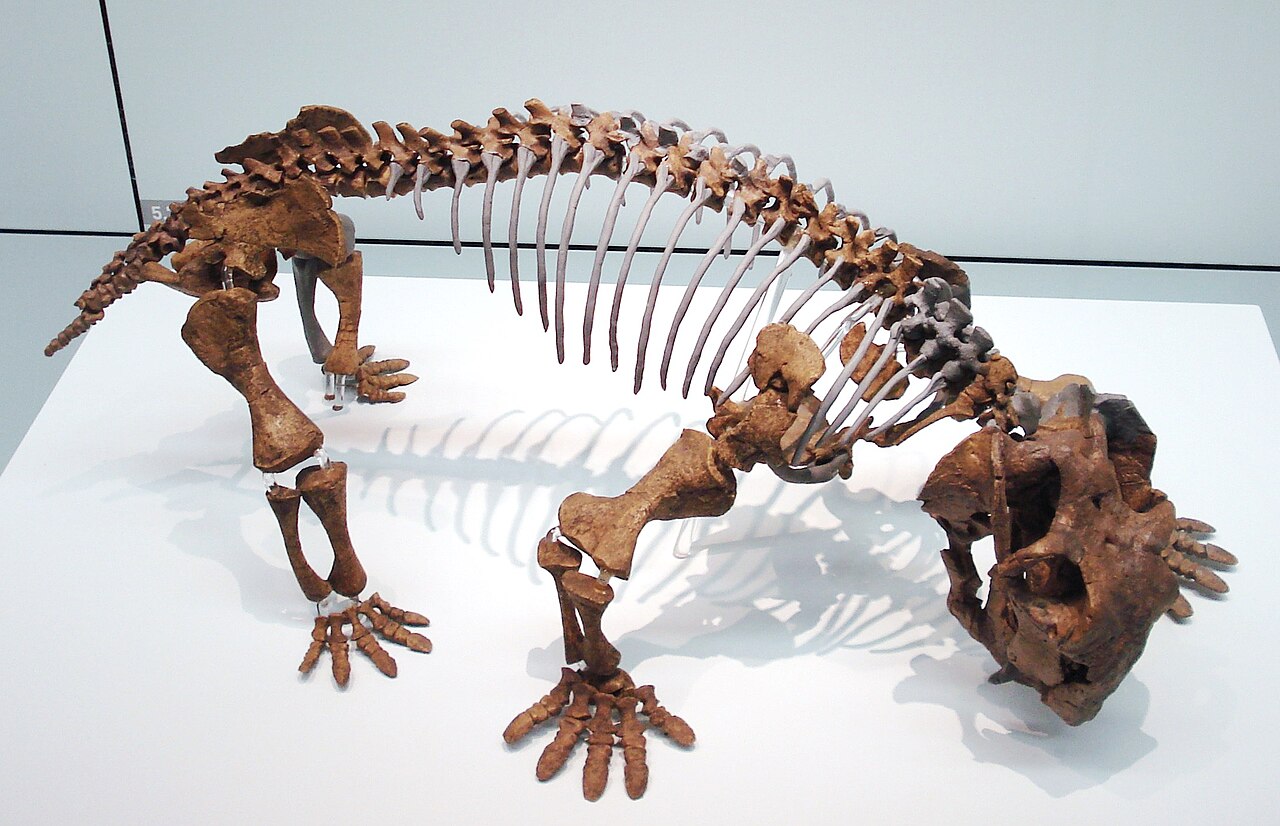
Lystrosaurus 1.JPG
The skeleton of a bog standard dicynodont, some obscure thing called Lystrosaurus I think...
By Ghedoghedo, CC-BY-SA 3.0


Or: A less-than-brief primer on dicynodonts.

The much delayed first proper post on this blog, partly through a combination of dreaded other obligations and having to cut down and rewrite the thing to keep it down to size, but it's out at last. If you're reading this blog in the first place, I'm presuming you already know a thing or two about dicynodonts. But for those of you who may be less familiar (and for the sake of completeness), here's what was intended to be a quick and rough rundown that outlines some of the basics of what dicynodonts are, their shape and appearance, and their evolutionary history across time.

The quintessential dicynodont Dicynodon lacerticeps
By Nobu Tamura, CC BY SA 3.0

Dicynodonts are synapsids, the group of animals that includes the modern mammals and their extinct relatives that branched apart some 312 million years ago from the line that would lead to living reptiles (birds included). Dicynodonts are among these (sadly) extinct relatives, and it used to be quite common to see dicynodonts and the other non-mammal synapsids be called "mammal-like reptiles" due to their apparent transitional nature. However, this term has fallen out of favour, since early synapsids aren't really reptiles as we define them anymore, either. Nowadays, the collection of non-mammalian synapsids is typically referred to as 'stem-mammals', which means that they are more closely related to the living group of mammals (crown-mammals) than to any other living thing alive today. Short, sweet and simple. As a part of this group, dicynodonts are also stem-mammals.

More specifically, dicynodonts are therapsids, a clade of synapsids more derived (and so, quote—unquote, "more mammal-like") than the earlier pelycosaurs such as the sail-backed Dimetrodon. Dicynodonts are one of the major groups of therapsids, along with the biarmosuchians, dinocephalians, gorgonopsians, therocephalians, and the cynodonts (←mammals go here).

The evolutionary relationships of therapsids is often portrayed like in the cladogram below, but it isn't always like this. Quite how dicynodonts are related to other therapsids is, perhaps surprisingly, still not fully resolved. Do dicynodonts group together with the dinocephalians? Are dicynodonts closer to mammals than the gorgonopsians are, or vice versa? Wherever they go, it is undisputed that dicynodonts are a real, natural group (monophyletic), and aren't just a hodge podge of unrelated animals that all just look similar. As such, they represent one of the 'core' therapsid groups, and were certainly major players in therapsid evolution.

Your typical cladogram of synapsid relationships (except when it's not).

Admittedly, I'm cheating a bit here and have deliberately left out the other anomodonts for simplicity, but I'm saving them for another post, or posts. Promise. Briefly, anomodonts are the wider clade that includes dicynodonts and their closest relatives, of which there are several and all just as peculiar as the dicynodonts are. If you can picture a few branches coming off the dicynodont main branch on that tree there, then that group all together would be anomodonts.

The crazy jaw muscles of dicynodonts,
demonstrated here by the tuskless
Sangusaurus parringtonii.
By Ali Nabavizadeh, from Angielczyk et al. 2017.
In a heavy handed generalisation of their appearance, all dicynodonts have a roughly similar body plan. They were all stout and dumpy quadrupeds, with broad, barrel-shaped bodies, and tails reduced to nubs. Their posture was somewhat functionally intermediary between those of early 'reptilian' amniotes and the later mammals, and many had upright hindlimbs paired with sprawling forelimbs, but variations and exceptions existed—and certainly not to suggest that dicynodont posture was 'halfway' between early amniotes and mammals (it's much more complex then that).

The skull is the most characteristic body part, with unusually short snouts and eyes set far forward on the skull to make room for truly massive jaw muscles behind them. As synapsids, dicynodonts only have one opening behind each eye (the temporal fenestra) to house these jaw muscles, but you'd be forgiven for thinking dicynodonts had more than one hole there at a glance. In dicynodonts, the zygomatic arch (a bridge of bone rimming the temporal fenestra) is often massively flared out from the skull and arched high over the cheeks, creating multiple areas of expansive muscle attachments. To go with these exceptionally powerful jaw muscles, most dicynodonts had some form of horny, keratinous beak, much like (to use that oft-repeated comparison) a tortoise's for cropping, slicing and chewing vegetation. And of course, their upper jaws often sported a single pair of prominent, tusk-like teeth.*

(*Of course, they don't all just have tusks, some have additional 'normal' teeth in their jaws, others have no tusks at all, and one or two have only 'normal' teeth but no tusks! 'Anomodonts' indeed.)

The skull of Dicynodon lacerticeps drawn
by Richard Owen in 1845, showing off the
original double dog teeth.
It was these tusks that got them their name. 'Dicynodont' means 'two canine-tooth', or more literally 'two dog-teeth'*, in reference to those characteristic tusks.** They were named in 1859 by this boffin called Richard Owen—you may have heard of him for that "Dinosauria" thing he did beforehand—based upon the eponymous Dicynodon itself, which he had named some years before in 1845.

Dicynodon would go on to become a bit of a taxonomic monster over the next century and a half (another tale worth chronicling another time), but at the same time Dicynodontia as a whole proliferated with an abundance of new taxa being described since Owen named them, branching off into numerous different lineages and families of varying sorts, even with the rampant lumping at hand. Suffice to say, from their fossil record it's clear that dicynodonts were an enormously successful group, highly diverse and impressively disparate for a group of herbivores with a reasonably conserved body plan.

(*Wink)

(**While I'm at it, the 'canines' of dicynodonts aren't really canines at all, in the sense that they're not homologous with the canines of other therapsids, including ours. Technically they're called caniniforms, but the name dicynoniformodonts is a lot less catchy.)

Dicynodonts first appear inconspicuously in the fossil record during the Middle Permian in South Africa, and then promptly exploded across Pangaea from the Middle Permian all the way through the Late Permian. During the Middle Permian, dicynodonts were fairly abundant but still smaller bit-players in their ecosystems, with big tapinocephalian dinocephalians occupying the role of large herbivores (though tell that to Endothiodon). Once the dinocephalians kicked the bucket, however, dicynodonts rapidly became the dominant herbivores on the scene, and by the Late Permian there were some very big dicynoconts indeed—some Permian giants such as the geikiid Rhachiocephalus had skulls that exceeded 1 metre in length! Permian dicynodonts came in all shapes and sizes (while adhering to the standard dumpy shape, I mean), and had adapted their teeth and beaks for a surprising manner of different lifestyles and diets. They even included some very small, mole-like forms that were evidently fossorial—adapted for digging and living in underground tunnels.

Deep in the dark, cramped tunnels of its burrow, Cistecephalus is coming for you...
...if you happen to be a worm. By Fabio Alejandro (Dragonthunders) (used with permission).

Then, like pretty much all of everything at the time, dicynodonts take a hard hit during the end-Permian mass extinction, (a.k.a. "The Great Dying", "The Big Die", and various other names) but quite impressively manage to make a comeback and ride a second wave of diversification during the Triassic. This was in direct contrast to almost all other therapsids, which died out during or shortly after the extinction, apart from the mammal-antecedent cynodonts (some dog-teeth solidarity there).

In fact, no less than five distinct lineages of dicynodonts would survive the extinction, but only one would go on to re-diversify during the rest of the Triassic, the kannemeyeriiforms. While not as ecologically diverse as their fore-bearers, the kannemeyeriiforms would nonetheless prosper as abundant large herbivores across the globe through the during Middle Triassic, diversifying into various distinct lineages. Alas, by the Late Triassic only one family was left, and while they remained geographically widespread, their diversity was gradually waning. Ultimately, they would die out just a few million years short of the end of the Triassic with little fuss or fanfare. A somewhat anticlimactic end for a lineage that survived the mother of all extinctions just 50 million years earlier.

A highly rigorous and authentic reconstruction of the end-Permian mass extinction through the eyes of Lystrosaurus (there's that name again), experience the horror for yourself here!

The tragic extinction of the dicynodonts during the end of the Triassic is itself ultimately a bit of a mystery, but they may simply have been a victim of the tumultuous climatic changes going on during the Late Triassic that reshuffled and reshuffled again the dynamics of Late Triassic ecosystems. Alternatively, it's been suggested that competition with herbivorous archosaurs was to blame. Whatever the cause, I think we can all completely agree that it's really unfair they didn't make it.

Regardless of how they met their demise, the dicynodonts left an impressive legacy behind; a hugely abundant fossil record spanning two eras and a mass extinction or two, a highly modified and specialised anatomy that made them one of the most common and successful herbivorous amniotes ever known, and presenting a staggering diversity of forms and function.

There's so much more I could talk about for dicynodonts, all the innovative specialisations in their jaws, beaks and teeth, what studies suggest about their metabolism, what their external appearance may have looked like in life. But this post is already long enough as it is, and I think this is a good spot to end it at. That and I wouldn't want to spoil the rest of the blog, after all.

References


Kemp, T.S. (1982). "Anomodonts". Mammal-like reptiles and the origin of mammals. Academic Press. London.

King, G.M. (1990) The Dicynodonts: A Study in Palaeobiology. Chapman and Hall. London and New York.